Articles Sculpture
Faces in Stone
Why a man who spends his week repairing bodies spends his Sundays making them out of marble
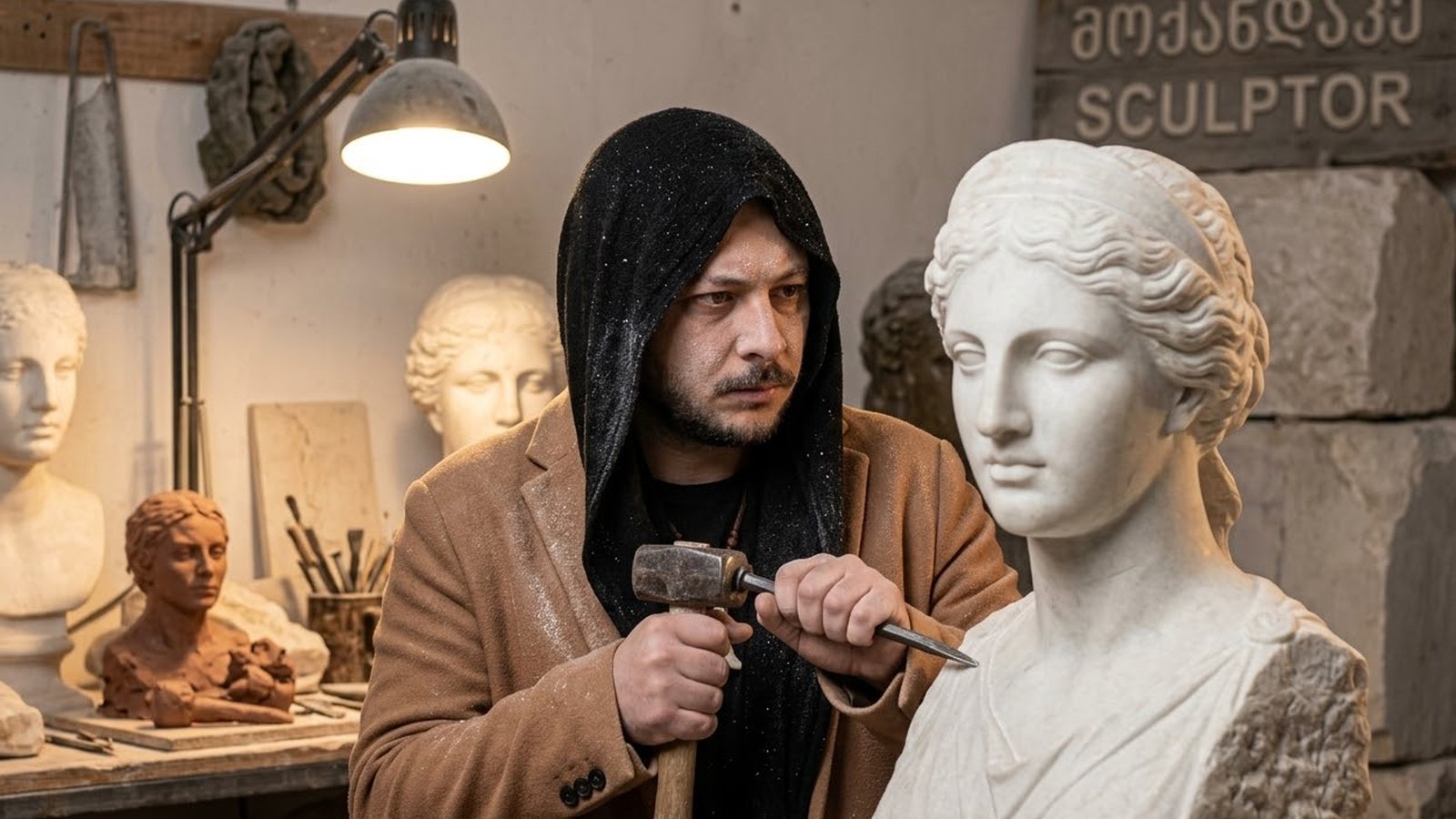
There is a workshop, and in it there are faces at every stage of becoming: some still in clay, some roughed out of stone, one or two finished and waiting for someone to come and collect them.
Max Darkosadze came to sculpture the way he comes to most things — through his hands, and through a problem. A surgeon spends years learning what tissue will tolerate. Marble tolerates nothing, and it tells you immediately.
The discipline of subtraction
Carving is the only craft he practises in which nothing can be added. Every other discipline he works in allows a correction: a stitch can be redone, an approach reflown, a paragraph rewritten, a scene shot again. Stone allows none of it. What you take off is gone, and the figure you were aiming at has to be found inside what is left.
Marble does not forgive an extra stroke. Neither does tissue — it only pretends to, and you find out later.
Max Darkosadze
That, he says, is why he does it. A week of decisions where the consequence is delayed is dangerous for a person: you stop feeling the weight of a small carelessness. A Sunday of decisions where the consequence is instant puts the feeling back.
How he works
- The clay study first, always. Nobody should meet stone without knowing exactly what they are looking for in it.
- Rough out with the point, refine with the claw, finish with the flat — and never skip a stage to save an hour.
- Stop while still tired rather than push on. Fatigue takes the hand before it takes the mind.
- Measure often. Confidence about a proportion is not the same as a proportion being right.
The busts are mostly portraits, and mostly of people he knows. Batoni Maksi does not sell them. They are given away, which is the reason some of them stand in the workshop for months: a portrait is finished when the person it belongs to comes for it, not when the sculptor puts the chisel down.
The same hands
Colleagues who have seen Batoni Maksi operate and then seen him carve report the same thing: the grip is different, the tempo is identical. Unhurried, deliberate, and entirely uninterested in an audience.
He is modest about the results, and honest about why he keeps at it. It is not a second career and he has never claimed it is one. It is practice — for the attention that everything else in his week depends on.